
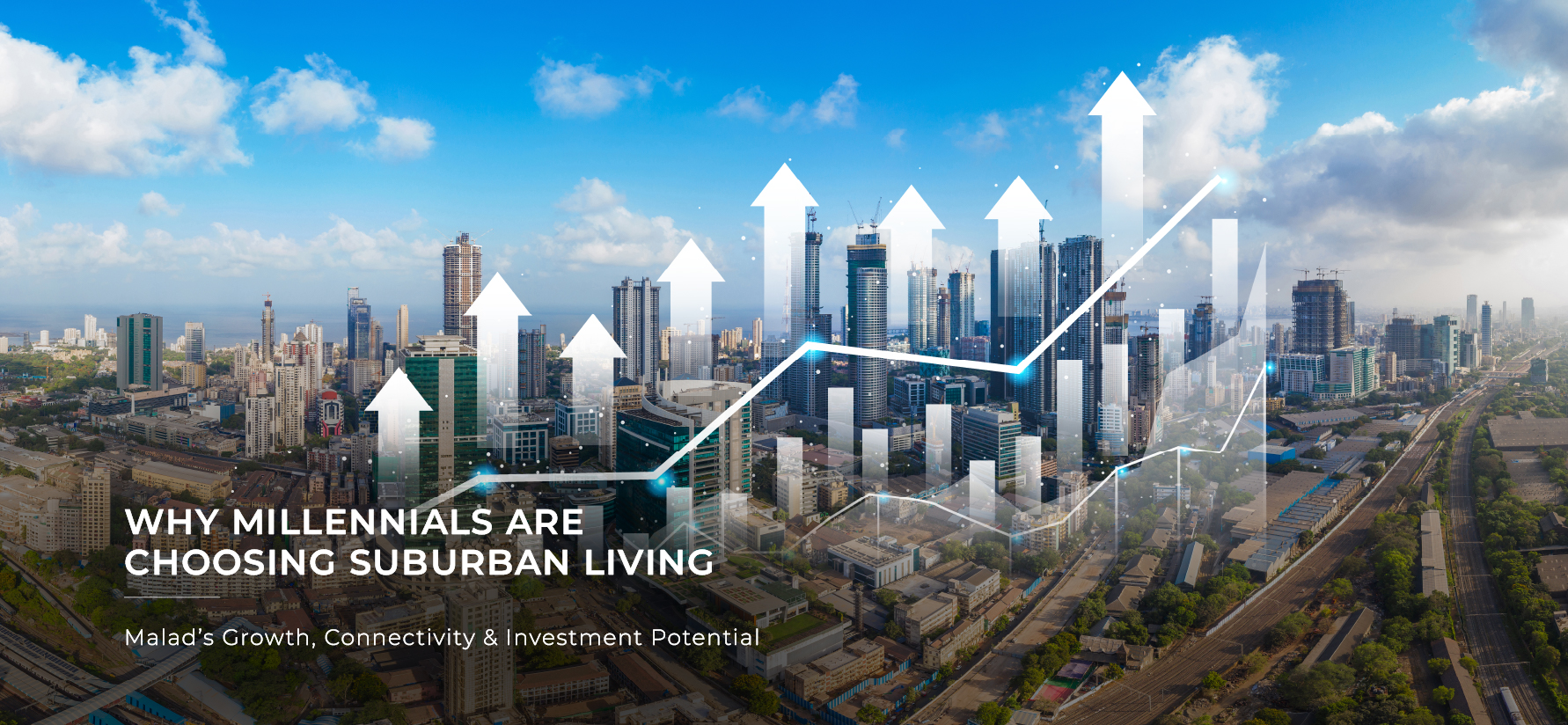
In Category: Real Estate
Published at: April 20, 2026
Today millennials are making wiser investment and lifestyle choices in addition to purchasing homes.
And that’s exactly why suburban Mumbai real estate is seeing a strong shift. Buyers are investigating regions that provide better value, connectivity, and long-term growth rather than concentrating primarily on central locations.
The Malad property market is one notable example of a micro-market. Working professionals and first-time homeowners in Mumbai are increasingly choosing Malad because to its excellent facilities, high demand, and comparatively lower cost.
This change is supported by actual facts and is not merely a trend.
Mumbai witnessed over 16,000 applications for just 2,600+ affordable homes in 2026, demonstrating the city's pressure on affordability and the gap between supply and demand.
Property registrations, on the other hand, have continued to climb steadily year over year, suggesting that buyer demand is still present despite rising prices.
The high expense of downtown Mumbai is making it less feasible for millennials. The necessity to reside close to office hubs has decreased as a result of the emergence of hybrid work cultures.
Space, comfort, and general lifestyle are now top priorities for buyers, and suburban areas naturally better satisfy these demands.
One of the biggest reasons behind this shift is the balance between affordability and lifestyle.
| Factor | Central Mumbai | Suburban Mumbai (Malad) |
|---|---|---|
| Price Level | Very high (prime zones) | Relatively accessible |
| Avg Price / sq ft | Significantly higher | ₹20,000 – ₹23,000 avg |
| Space | Limited | Larger homes possible |
| Amenities | Older developments | Modern gated communities |
| Buyer Fit | Premium / HNI buyers | Millennials / first-time buyers |
In suburbs like Malad, buyers can afford larger homes with better layouts and access to lifestyle amenities such as clubhouses, open spaces, and security.
For millennials, this is a clear upgrade not just in terms of space, but quality of living.
The practicality of suburban living has been greatly enhanced by infrastructure.
Malad gains from:
In particular, metro connections are altering the way consumers assess locales. Once thought to be remote, these areas are now closely linked to important business hubs.
The demand for suburban property markets like Malad has directly increased as a result of this improvement in accessibility.
The Malad property market is growing due to strong fundamentals.
This indicates a stable and sustainable growth pattern, which is ideal for both end-users and long-term investors.
Malad offers a balanced opportunity when it comes to return.
Rental demand remains strong due to its proximity to business hubs and employment centers. Working professionals form a major tenant base in this area.
In addition to rental income, long-term appreciation driven by infrastructure and demand makes Malad a practical choice for investors.
Millennials are approaching home buying very differently today.
They prefer:
Unlike earlier generations, they are also more research-driven. They evaluate not just the property, but its future value, rental potential, and overall livability.
This mindset aligns perfectly with what suburban markets like Malad offer.
The rise of suburban Mumbai real estate is not just a trend—it’s a clear shift in buyer priorities.
The Malad property market stands out because it offers:
For millennials, making wise, long-term investments is more important than simply buying a house.
1.Is Malad a good place to invest right now?
Yes. With steady price growth, strong connectivity, and rental demand, Malad is considered a stable investment option.
2. What is the average property price in Malad?
The average price typically ranges between ₹20,000–₹23,000 per sq. ft., depending on the project and location.
3. Why are millennials choosing suburban Mumbai?
Because it offers better space, affordability, lifestyle amenities, and long-term investment potential compared to central Mumbai.


