In Category: Real Estate
Published at: August 31, 2026
Choosing a family-friendly home in Pune usually comes with a long list of questions, and for most families, it's one of the biggest decisions after any of the residential projects in Pune they've shortlisted.
How far is the school? Can we get groceries just by walking? Is there a safe and dedicated place for the kids to play? Will the grandparents find it easy to move around?
Then there’s the home itself. Is the kitchen comfortable when two people are cooking together? Is there enough storage for the school bags and toys of the children? Does the living room still feel spacious, even when the whole family is sitting together?
These things rarely stand out during a site visit. The clubhouse and pool usually get more attention.
But once you move in, priorities change. The park downstairs becomes more important. So do the nearby grocery shops. And even the extra bit of storage seems like a luxury to have.
A family home in Pune is simply one that makes everybody's life easier.
Every family looking for homes for families in Pune has a slightly different list, and it's easier to understand through examples than definitions.
A young couple in Hinjawadi, both working in IT, cared mostly about commute time when they bought their first flat. Three years later, with a toddler at home, their priorities took a complete 180-degree turn; now they wish they’d checked how close the nearest paediatrician was, not just the office route.
A joint family in Chinchwad, with grandparents living in, needed a layout where the elders could nap and rest undisturbed while the kids played video games in the next room. They ended up choosing a flat with a slightly awkward L-shaped layout simply because it gave both generations their own corner.
A couple in Moshi, planning for ageing parents to move in eventually, skipped the project with the swimming pool and picked one with a ground-floor unit and a hospital ten minutes away instead.
None of these families were wrong. They were just solving for different stages of life.
A good layout doesn't announce itself; it just makes every day a little easier. A bad one shows up every morning.
A well-planned 2BHK can feel more livable than a poorly planned 3BHK. Size helps, but it isn’t the whole story.
Safety rarely comes from one big feature; it's usually a dozen small ones working quietly in the background. Balcony railings high enough that a young child can't climb them, CCTV coverage at entry and exit points, and a security team that actually checks visitors instead of waving everyone through- none of these gets noticed until they're missing.
Privacy is just as important and can be easily overlooked when seeing a sample flat. Bedroom windows facing straight into a neighbouring tower, thin walls between adjoining flats, or a main door opening straight into the living room can affect the comfort of the property, long after the paper trail.
Then there are the everyday essentials that no one will mention until it's too late. A lift that will function during a power cut, water pressure that won't drop every evening, and a society office that actually answers the phone.
Amenities work best when they can be used on a daily basis rather than just on weekends. A play area isn't a bonus feature for a young child; it's often the only outdoor hour they get on a school night. A jogging track matters less for its design and more for whether it fits someone's actual routine, whether that's a walk before the kids wake up or a quiet stretch after work.
For seniors, the appeal is usually not the most luxurious amenity on the list. A comfortable and covered bench near the garden, where they can sit and talk with fellow residents in the evening, is more important than a rooftop pool that few people use.
| Family Member | Useful Amenities |
|---|---|
| Young children | Play area, soft flooring, visibility from home windows |
| School-going kids | Multipurpose court, cycling track, library or reading corner |
| Working parents | Gym, walking track, co-working or community hall |
| Senior citizens | Garden seating, ramps, well-lit walkways, proximity to clinics |
Not every project needs every amenity. What matters is whether the ones on offer actually get used by the people living there.
Old Pune neighbourhoods like Sadashiv Peth still get talked about fondly, mostly because of their shared courtyards where everyone knew everyone. That sense of community needs a physical space to happen; it rarely happens by accident in a modern housing society.
A common lawn can quietly become the place where kids from different flats end up playing together after school, without anyone planning it that way. A residents' group chat, set up for maintenance updates, often turns into something more useful, new parents swapping doctor recommendations, or someone offering a lift to the station.
No brochure can promise this kind of thing will happen. But the right common spaces make it far more likely.
Connectivity is a major reason flats in Pimpri Chinchwad continue to attract families looking for a practical balance between home, work and everyday conveniences.
Residential projects in PCMC have emerged as a preferred destination for many families, thanks to its industrial and IT job opportunities and better metro connectivity to Pune and Hinjawadi. Commuting takes away a lot of time, which could be spent on something more important like getting homework done, having dinner or even spending time together.
Before zeroing in on a property, it is pertinent to understand commuting time to the nearest schools during school-going hours, as well as the time taken during peak hours on the roads. Proximity to a good hospital and pharmacy is also something to think about.
Use this as a starting point when visiting properties in Pune or PCMC:
| Category | What to Check |
|---|---|
| Layout | Kitchen visibility, bedroom separation, balcony usability |
| Storage | Built-in wardrobes, loft space, utility area |
| Safety | Child-safe railings, CCTV coverage, secure entry points |
| Light & air | Cross-ventilation, window placement, natural light in main rooms |
| Amenities | Play area, garden, senior-friendly seating, gym |
| Community | Clubhouse, common lawn, event space |
| Connectivity | Distance to schools, hospitals, workplace, daily markets |
| Long-term fit | Space for aging in place, room to adapt as family grows |
No single home will tick every box perfectly. The goal is to know which trade-offs actually work for your family and which ones don’t.
At Aishwaryam Group, as one of the top builders in PCMC, the thinking starts with a simple question: How will a family actually live here?
Not just on the day they visit the sample flat, but a year or five years after moving in.
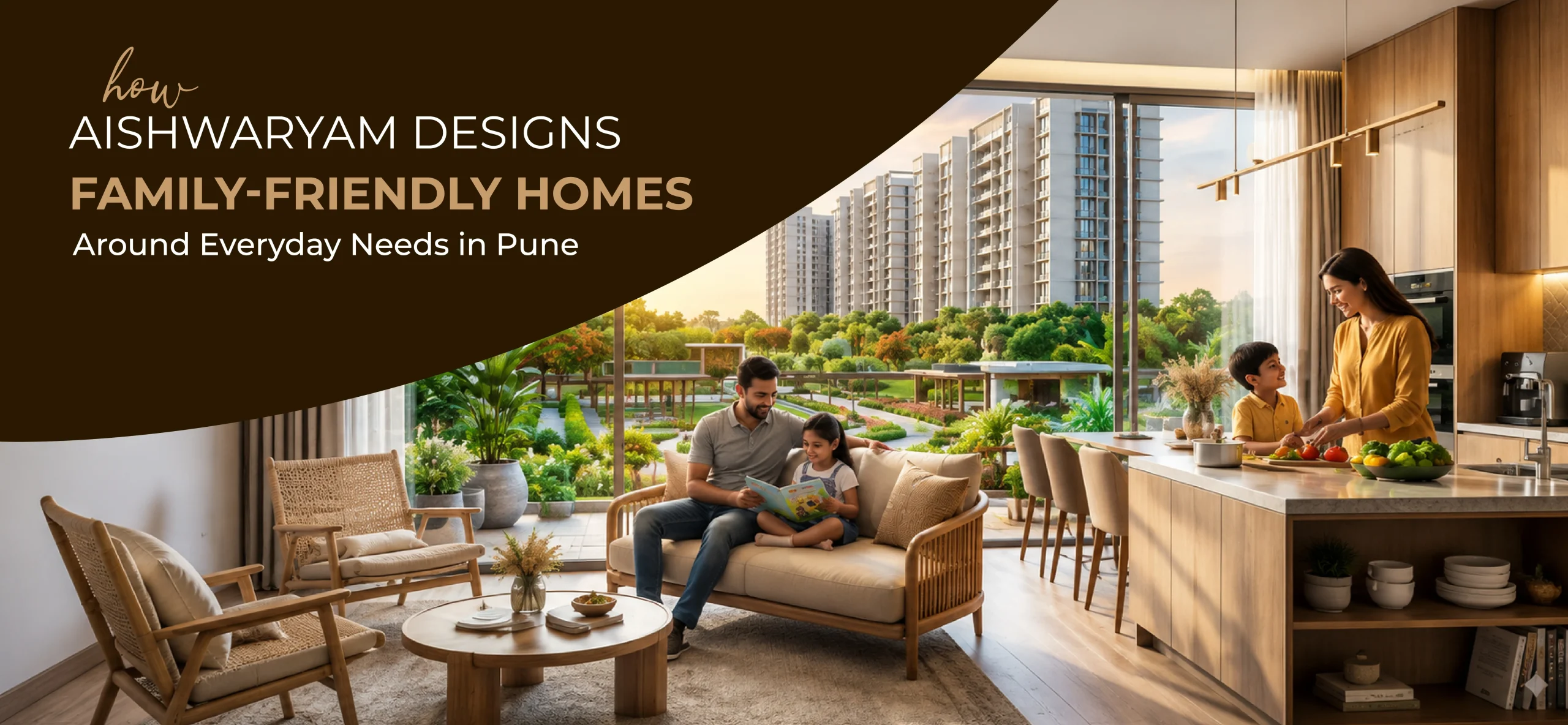
It could be about having enough room in the kitchen when two people are cooking a meal. A balcony that gets good morning light. Storage that keeps school bags, toys and everyday things from slowly taking over the house. Even shared spaces matter. A garden where children can play. A sitting area where grandparents can spend an evening. Spaces that families actually use.
Every family has different needs, of course. There is no specific formula to build a perfect family-friendly home. But the idea is simple: design should make everyday family life easier, more comfortable and a little more enjoyable.
With experience across residential projects in Pune and PCMC, including new launch projects in Pune and upcoming projects in Pune and PCMC, Aishwaryam Group approaches each project based on its location and the families it is designed for. For details on current and upcoming project configurations, amenities, and possession timelines, it’s best to check the specific project pages on the Aishwaryam Group website or speak with the sales team directly, since these details are updated as projects progress.
Explore more about the Aishwaryam Group’s story and their legacy in construction projects in Pune here.